Pages

Showing posts with label Pattern Blocks. Show all posts

Friday, October 16, 2015

Flashback Friday: One of my best Common Core Posts from last Oct.

When The Teacher Becomes The Facilitator:

This was a super-popular post that I wrote last year:

We were exploring all of the ways to create 6.  I didn't give any directions; I only gave my small group of four students 6 double-sided (red & white) chips and the ten frames I won at I Teach K last summer.   I asked a few questions, but mostly I just let them discover on their own or with a partner.
"I arranged my chips in a different way than you did,
but we both have 2 white chips and 4 red chips."

At first, I just let them play with the ten frames and chips. 

Then, The Magic Happened:

Let me show you how to make an AB pattern with your chips.


They explored and discussed so many ways to create 6.  

They learned from each other.

They helped each other.

They used their words and had so much fun making different combinations of 6.

How many more do I need to get to ten?
You can get these plastic double ten-frames at Lakeshore.  Click HERE for the link.

Now, we will complete page 6:

Each week, we created a picture using one or two shapes.  On week one we used only one piece.
We made one of these things: a sun, a kite, a gift, a bowl, a tee-pee, or a fish.

Students were also encouraged to come up with new things to make out of only one piece. 
Student may choose one of these or create their own.


On week 2 we used 2 pieces.  They could be 2 of the same piece or 2 different pieces.

Can you see how the house is 1 + 1 = 2, but the bird is 2 + 0 = 2?
Sorry about the paint on the sunglasses :o/


On week 3 we used 3 pieces.  They could pick 3 pieces that were all the same or 2 different shapes (1 of one shape and 2 of another shape), but NOT 3 different shapes.

Can you tell why the face is 3 + 0 = 3, but the cat is 2 + 1 - 3? 
Imagine the fun your kids will have creating objects with all one shape or two shapes.


After we created the picture, we completed the sentence with words.  This is what page 6 might have had on it:
My students came up with these.


 Then, we wrote:  6 is a ________.  (flower, star, ship, etc.  They got to pick one.)


I printed 2 of the same page on each master so you can simply copy
the entire packet, cut the pages in half, and staple both mini books.

Then, we completed the number sentence that went with the picture:  
0 + 6 = 6
1 + 5 = 6
2 + 4 = 6
or 
3 + 3 = 6

This makes a great book to keep for Open House.  

You can find my Addition Book by clicking HERE.


Wednesday, August 12, 2015

Managing Your TK/K ~ Part III: Small Groups


Differentiating With Small Groups:

While my kids are working on their independent table work, I call up small homogeneous groups of 4-6 students for small group lessons. I keep the same theme (ELA, math, science, or social studies concept), but I differentiate how I present it and what I expect the children to do. Here are some examples:
My Small Group Table. This is a photo of the students' work mats.
I just attached lined dry-erase contact paper to 2 of the mats.
They also have a number line and a set of alphabet letters and animals that begin with each sound. 

ELA:
TK: 
1st, students place a cube on each picture that begins with /J/(this allows me to use these pages year after year).
2nd, they trace the uppercase J and the lowercase J on laminated cards with a dry-erase pen. (Pens are easier to maneuver and they can erase the card and it's ready for the next student.)
3rd, they move to the carpet where they poke a hole in every dot of the dotted letter cards. (They get to take these home and hang them on a window to let the light shine through and illuminate each letter. )

Click the image to see the dotted alphabet cards.
K: 
1st, they place their cube on the /J/ pictures and brainstorm other words that begin with /J/ and try to write them on their dry-erase work mat.
2nd, they trace the uppercase J and the lowercase J on the laminated cards and evaluate their work by circling their best uppercase J and lowercase J.
3rd, they work together to create a group sentence using as many /J/ words as possible and we network as we all write that group sentence on our dry-erase work mat. 
OR... you can have each child complete the sentence: I like ________. The blank must begin with the sound of /j/.

More Differentiated ELA Lessons:

Instant Writing:
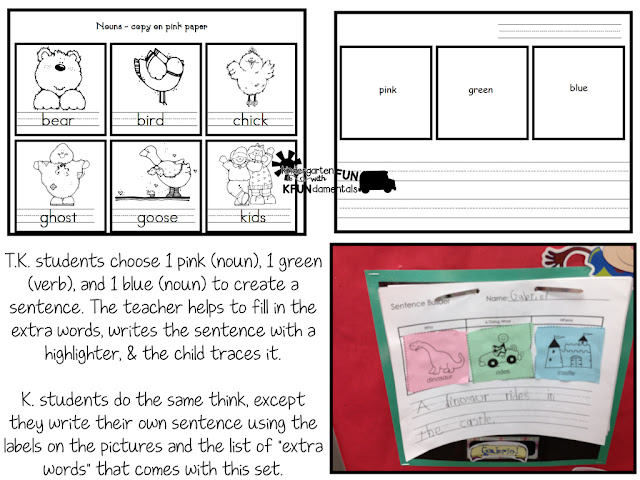
Students use the graphics, which are printed on colored paper, to compose a complete sentence. 
I also use a page of "extra words" such as "the, a, an, my, your, our, near, by, around, through, under, over, next to..." to help students complete their sentences.
Click the image above to see the entire Instant Writing set. https://www.teacherspayteachers.com/Product/Writing-Instant-Sentences-Perfect-for-beginning-writing--1116456

Writing About Colors:
These pages make great class books. The first one will have a page for each child's name.
The second one will show something that is the color mentioned on that page.
This set makes 12 wonderful class books.
Click the image above to see the entire Color Writing Pack.
It includes templates to create 12 books. 


Math:
TK:
1st,  Using my Number Pack, students complete the individual number page with help from the teacher.
2nd, then they create an object, using die-cut Pattern Blocks, to create an object that totals 3. (They may use all the same shape or 2 different shapes.) The goal is to match the pre-written number sentence which might be 2 + 1 = 3 or 3 + 0 = 3. The teacher is just introducing the pre-written equation as the students use the Pattern Blocks to create an object. I usually don't do this type of lesson until about Feb.
Click any of the images above to see the entire Number Pack.

Click any of the images above to see the entire Number Pack.

K: Using my Number Pack, students complete the individual number page independently. 
2nd, they create an object using the die-cut Pattern Blocks as above, except that the equation lines are blank and they have to decide which numbers to write on the lines to match the object they built. The students are building their academic vocabulary by using words like "plus" and “equal".

More Differentiated Math Lessons:

Rekenreks: 
These unique number racks have five white beads and five red beads which help your students to instantly see, or subitize, the numbers 6-10. They can easily make them using Fun Foam, pipe cleaners, and pony beads. 


Shopping:

What better way to apply math skills than through shopping?
I usually have 2-4 students do this activity with me at one time. While I let one student shop, the others watch so they are ready to shop when it's their turn. I set out all of the products, I create a menu with prices, I provide the money, an we collect the items purchased in a Zip-lock bag that has the child's name on it and a receipt. Once everyone has shopped, we create our monsters (or cats, see further below). These make a great bulletin board displayed along with each individual receipt.

Click the image above to see my shopping receipt set.
 Addition:

Students use manipulative to compose addition sentences. This can also be reversed to use with subtraction.
Click the image above to get the 1-10 number pack.
 Measurment:

Students measured, using cubes, they weighted, they estimated, and they talked about math!
This was a fun activity to do around St. Patrick's Day.

More or Less:

Students loved using Fun Foam letters to create "more" or "less" in each group.
They also enjoyed using the <, =, & > signs made from tongue depressors, google eyes, and Fun Foam for the teeth.
Click on the image above to see my More or Less set.